Thompson Foundry Innovations

Thoughtful systems for difficult problems.

TFI is an independent company that develops reusable systems for information and technology problems that deserve a closer look.

Our current focus is Discover Engine, a tool for seeing how a business appears across selected public sources.

Early working preview

Try TFI Signals, the current public experience, powered by Discover Engine. It shows how selected public-source information can be organized into a preliminary report. It is a working example of the direction—not the finished product.

Current focus · Discover Engine

See what public sources say about a business.

TFI Signals reviews selected public information about a business and organizes what it finds into a report.

The report makes it easier to see what aligns, what differs, what appears older and what still needs review, with context about where the information came from.

Available now

TFI Signals, an early public check.

Search by business name and city or area. If several businesses match, choose the right one, then view existing research or request a fresh check.

Check a business →

Other work at TFI

Systems exploring other difficult problems.

Context continuity

Waypoint

Maintains an evolving picture of a person’s situation, detects ripple effects and proposes a clear next step.

Explore Waypoint →

Functional prototype

Knowledge organization

Thought Ledger

Turns scattered thoughts, notes, research and conversations into persistent topic-based knowledge.

Explore Thought Ledger →

Functional prototype · Active internal use

Neuromorphic edge sensing

NeuroEdge

A proposed localized architecture for processing event-based sensor information at the edge.

Explore NeuroEdge →

Patent-pending architecture

The Workshop · Functional prototype in active personal use

A structured workspace for a user’s own Markdown study material.

The Workshop turns uploaded or pasted Markdown files into a nested roadmap, a glossary built from the notes’ own wiki-links and persistent manual checklist tracking. It organizes user-provided material; it does not supply courses, evaluate learning or use AI.

Research and collaboration

Build understanding before making claims.

If you are working through a difficult research, information or systems problem, TFI welcomes a focused conversation.

Start with the problem.

Tell us what you are trying to understand, what evidence you already have and where the current tools fall short.

Contact TFI
Discover Engine

See how a business appears across public sources.

Discover Engine checks selected public information, compares what the sources show and organizes the result into a clear record you can trace back to its source.

What it helps you see

One business can look different depending on where you look.

A search may find information that matches across sources, contact details that differ, older public material, public technical signals or details that still need review. Not every search returns every kind of observation.

What lines up

See when multiple checked sources report the same or closely matching information.

What differs

Notice conflicting details or older material without quietly choosing one version as correct.

What needs review

Keep unclear information visible, with enough context to decide what deserves another look.

The report

A clear record of what the checked sources reported.

The report brings the observations for one business into a structured summary. It keeps useful context with the result, including the source, timing and how strongly the information lines up across the checked sources.

It is designed to make scattered evidence easier to read and compare—not to replace direct confirmation with the business.

Business research is the first use

A reusable approach to public evidence.

Discover Engine begins with business research, but its broader purpose is to help organize and compare public evidence around other focused questions over time.

A careful view

What the sources show, with the limits left visible.

Discover Engine shows where information came from and where public sources agree or disagree. Agreement can add context, but it is not independent proof that every detail is correct.

Public information only

TFI Signals does not access private accounts and does not claim to cover the whole internet. It reports what its selected public checks found and marks unclear information for review.

Available now

Use TFI Signals today.

Search by business name and city or area. If several businesses match, choose the intended one. You can then view existing research or request a fresh check.

Check a business

Looking ahead

MainStreet Local

MainStreet Local is planned as the first future business application of Discover Engine. Additional ways to review and work with results are still being developed.

Research and collaboration

Interested in the work behind Discover Engine?

TFI welcomes conversations about relevant research, public-information problems and thoughtful ways to work with evidence.

Bring a problem or perspective.

Share what you are trying to understand and why the available information is not enough.

Contact TFI

Waypoint

Context that changes when life changes.

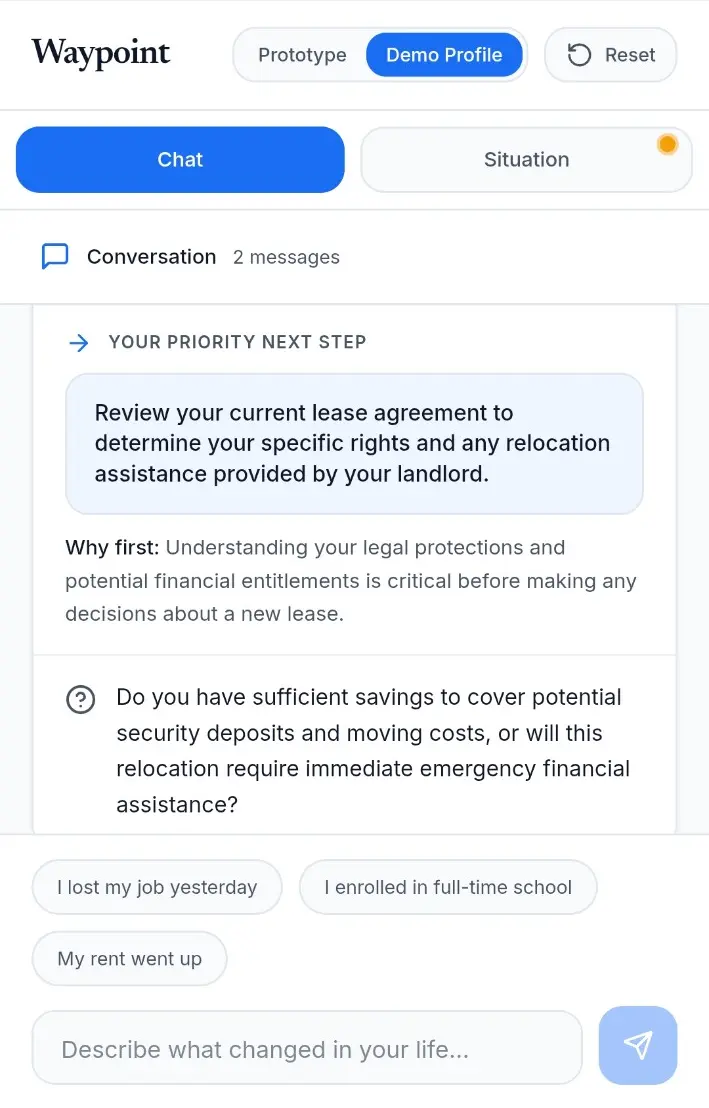
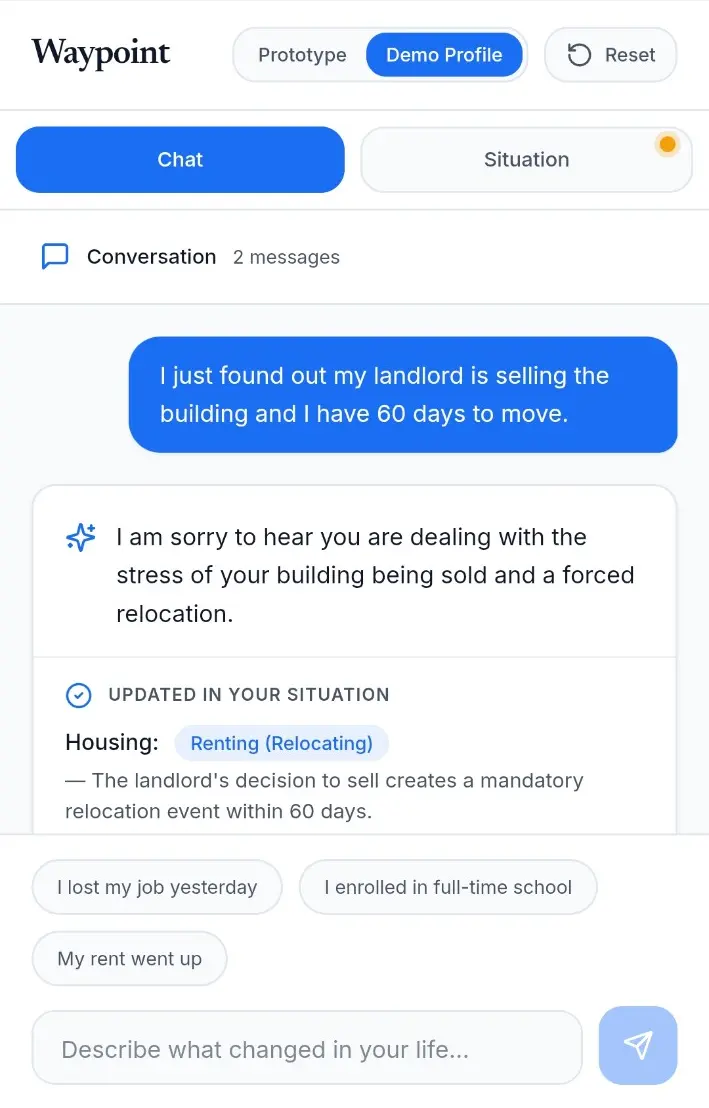
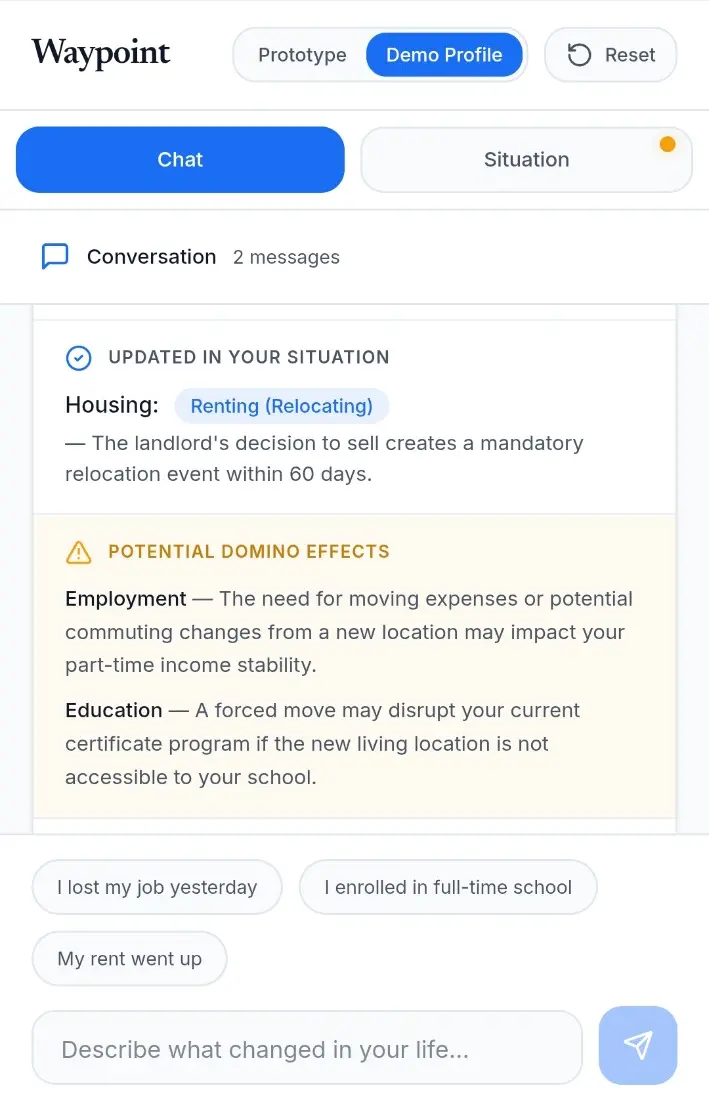
A functional prototype that turns a reported life change into an updated situation record, possible cross-domain effects and one prioritized next step.

A working architectural demonstration

An evolving picture of a person’s situation.

Waypoint accepts a change in plain language, updates the relevant life category, preserves the prior value in a change history and explains why one suggested action comes first.

The prototype demonstrates a general life-transition architecture. VetBridge, neurodivergent support and other specialized applications remain concepts rather than operational products.

Current boundary

State persists only in the user’s current browser. Updates are applied without a confirmation gate, and no crisis safeguards, professional-advice support, accounts, cloud sync, voice input, passive sensing or NeuroEdge integration are implemented.

Fictional mobile demonstration

Change recognized. Effects connected. Next step prioritized.

Jordan is a fictional profile created only for demonstrating the system. No personal data appears in these screens.

Thought Ledger

Turn scattered thoughts into connected knowledge.

A persistent knowledge workspace for ideas that develop over time—across notes, research, documents, decisions and conversations.

A place for evolving context

Not another pile of disconnected notes.

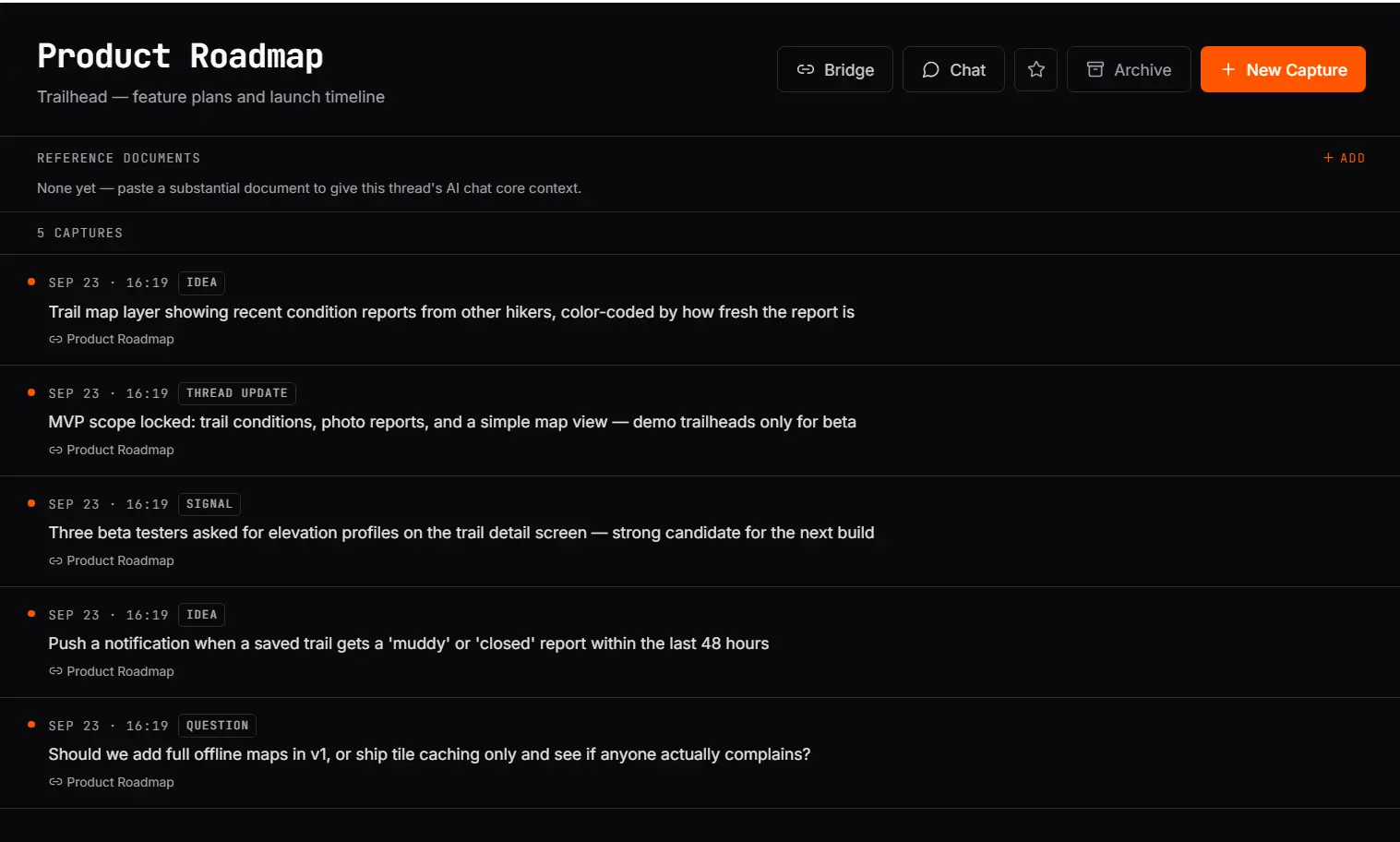
Thought Ledger captures raw material and organizes it into topic-based Threads, where context can accumulate instead of being lost across separate tools and sessions.

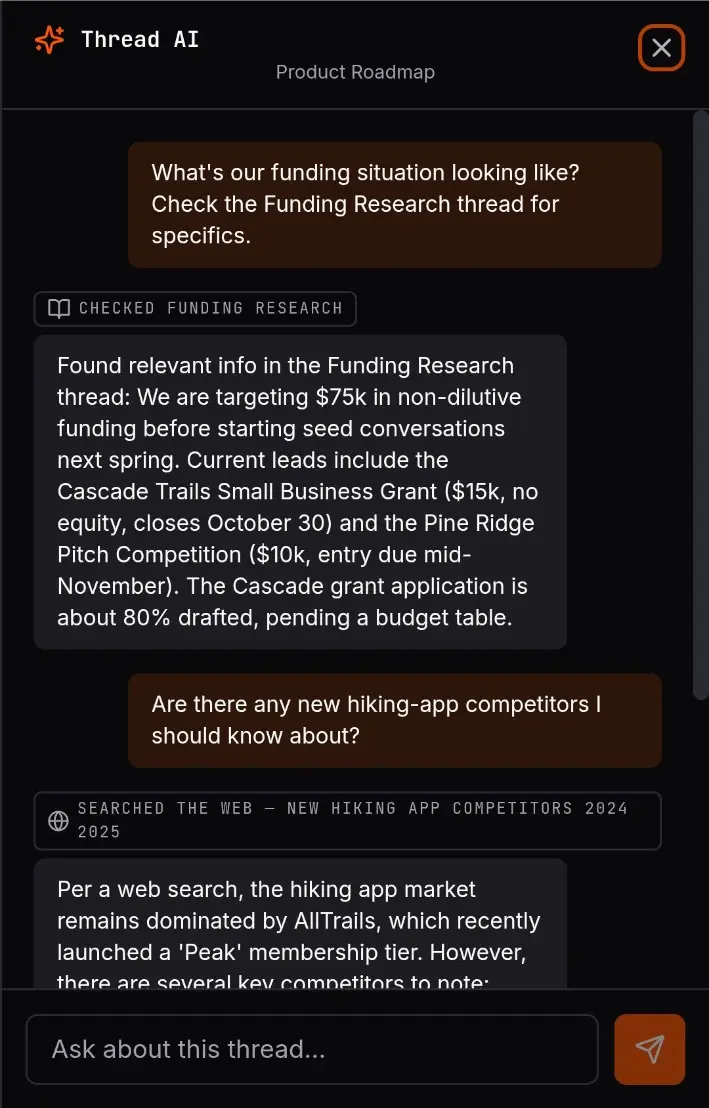
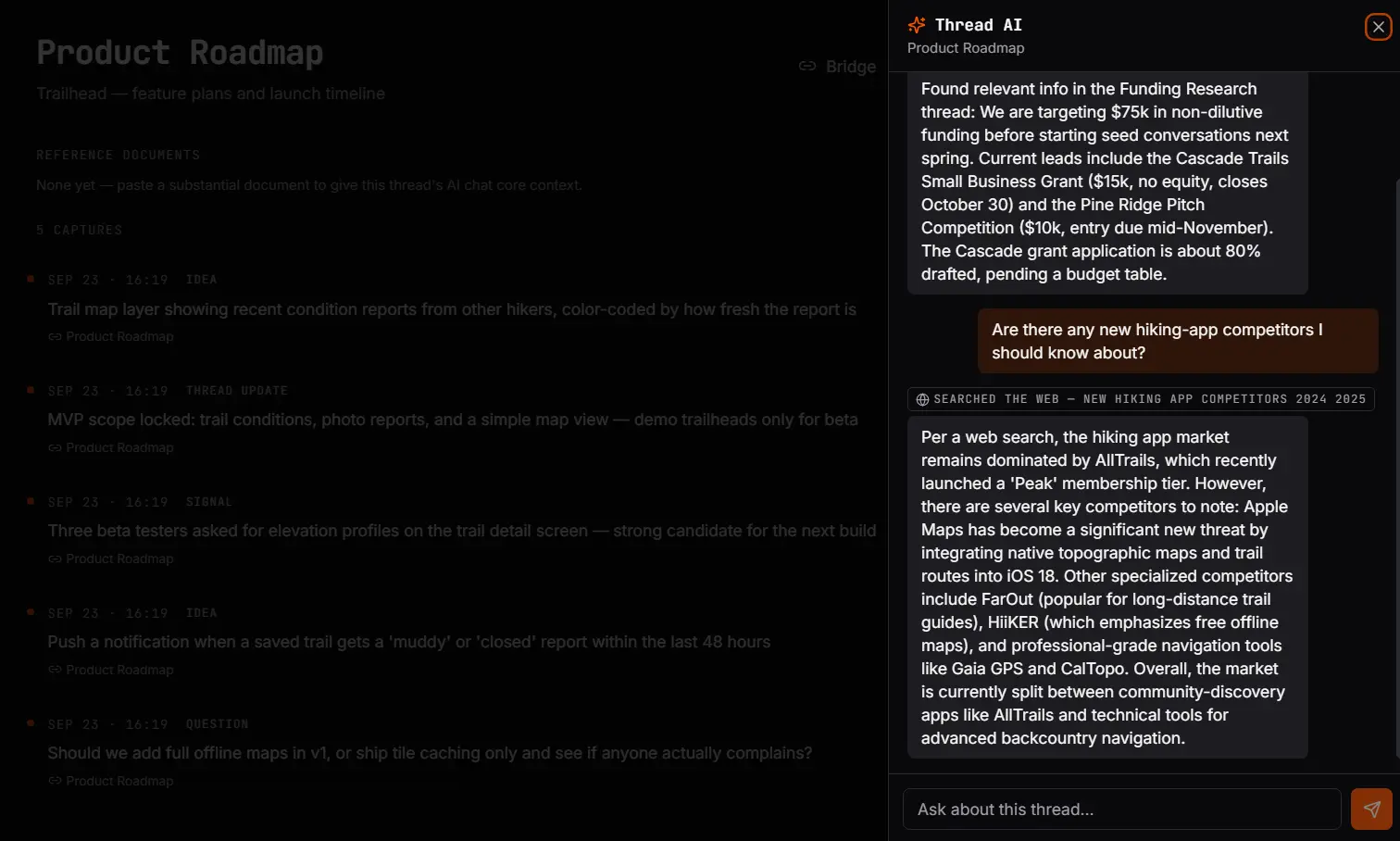
Its AI capabilities can sort captures, answer from a Thread’s accumulated context, check a related Thread when relevant and search the web when current outside information is needed. AI supports the knowledge workspace; it is not the entire purpose of the product.

Fictional Trailhead Product Roadmap thread in Thought Ledger

Fictional Trailhead demonstration data

Functional prototype · Active internal use

Built for subjects that keep growing.

Thought Ledger is currently a private, single-user system. These examples show possible uses, not tested markets or public availability.

  • A writer’s characters, themes, research and draft decisions
  • A researcher’s evidence, sources and unresolved questions
  • A founder’s product roadmap, market research and funding work
  • A student’s notes, references and developing understanding
  • A homeowner’s renovation plans, estimates, permits and repair history
  • A caregiver’s resources, questions and changing responsibilities
  • A community group’s projects, contacts and meeting outcomes
  • A hobbyist’s experiments, materials and next ideas

Working capabilities

Organize first. Then reason across what has been organized.

Capture and sort

Dump & Sort identifies distinct ideas, proposes Threads and keeps a person in control before saving.

Persistent context

Captures, reference documents, version history and conversation accumulate around the subject.

Visible source behavior

The chat shows when it answered locally, checked another Thread or searched the web.

NeuroEdge

Sense change. Process locally. Preserve only what matters.

A proposed neuromorphic edge architecture for converting physical change into sparse events, processing those events locally and minimizing unnecessary raw-data movement.

Architecture

A local event-processing path.

The proposed architecture converts physical change into a sparse event stream, processes it locally and retains only the result required by the application.

Hybrid frame-event sensor

Physical changes are captured through frame and event signals.

Encoding and filtering

Relevant changes are filtered and converted into sparse events.

Event stream

An AER-equivalent representation carries events without reconstructing continuous frames.

Neuromorphic processing

An NPU or spiking neural network processes the event stream locally.

Local classification

The system produces the application-relevant result at the edge.

Data destruction

Raw or intermediate data can be discarded after the required result is produced.

Why local processing matters

Less data movement. Faster response. Clearer privacy boundaries.

Automotive and fleet safety

Explore rapid local interpretation of relevant physical events without continuous cloud dependence.

Healthcare and biometric sensing

Explore privacy-conscious local classification where transmitting raw sensing data may be undesirable.

Verification and anti-spoofing

Explore event signatures that help a device distinguish meaningful live change from static or replayed input.

These are research and application directions. They are not claims of a manufactured, clinically validated or deployed product.

Patent status

Architecture under development.

U.S. Provisional Patent Application No. 64/070,641, “System and Method for Localized Neuromorphic Event-Based Edge Sensor Optimization,” filed May 20, 2026.

Current work

TFI is refining the architecture, examining prior art and identifying application partners and technical paths for evaluation. Performance has not yet been independently measured or validated.

Discuss research or technical collaboration →

About TFI

An independent systems-development company.

Thompson Foundry Innovations LLC is a California company developing original systems, architectures and research around difficult information and sensing problems.

The company

Systems before standalone products.

TFI does not begin by forcing every problem into an app. It investigates the underlying structure, develops reusable capabilities and then considers which applications, partnerships or deployments make sense.

The current portfolio spans evidence intelligence, contextual assistance, personal knowledge organization, study-system architecture and neuromorphic edge sensing.

Founder

Steven Thompson

Founder and systems architect.

Steven’s work is shaped by a practical interest in fragmentation: what happens when useful facts, responsibilities, signals or ideas exist but cannot be seen together. His role combines problem definition, applied research, architecture, prototyping and technical documentation.

Working principles

Clear boundaries matter.

Evidence before certainty

Preserve sources, identify unknowns and distinguish demonstrated behavior from future direction.

Automation needs boundaries

Show what a system checked, how it reached an output and where human confirmation is still required.

Architecture should adapt

Develop reusable foundations, then test them through focused applications without pretending every context is the same.

Contact

Bring a problem, an idea or a capability.

TFI welcomes focused conversations with research partners, technical collaborators, public-sector and economic-development organizations, mentors and potential application partners.

Start with what you are trying to understand or change.

You do not need to arrive with a finished specification. Useful conversations often begin with the friction, missing structure or information that current tools cannot reconcile.

Thompson Foundry Innovations

Steven Thompson

Founder and Systems Architect

Serving Orange County, California

contact@tfi-systems.com

(714) 684-6576

Monday–Friday: 9:00 AM–5:00 PM
Saturday: 10:00 AM–2:00 PM
Sunday: Closed